
Structuring Striking Class Levels - Sean Madden (E54)
Dec 19, 2025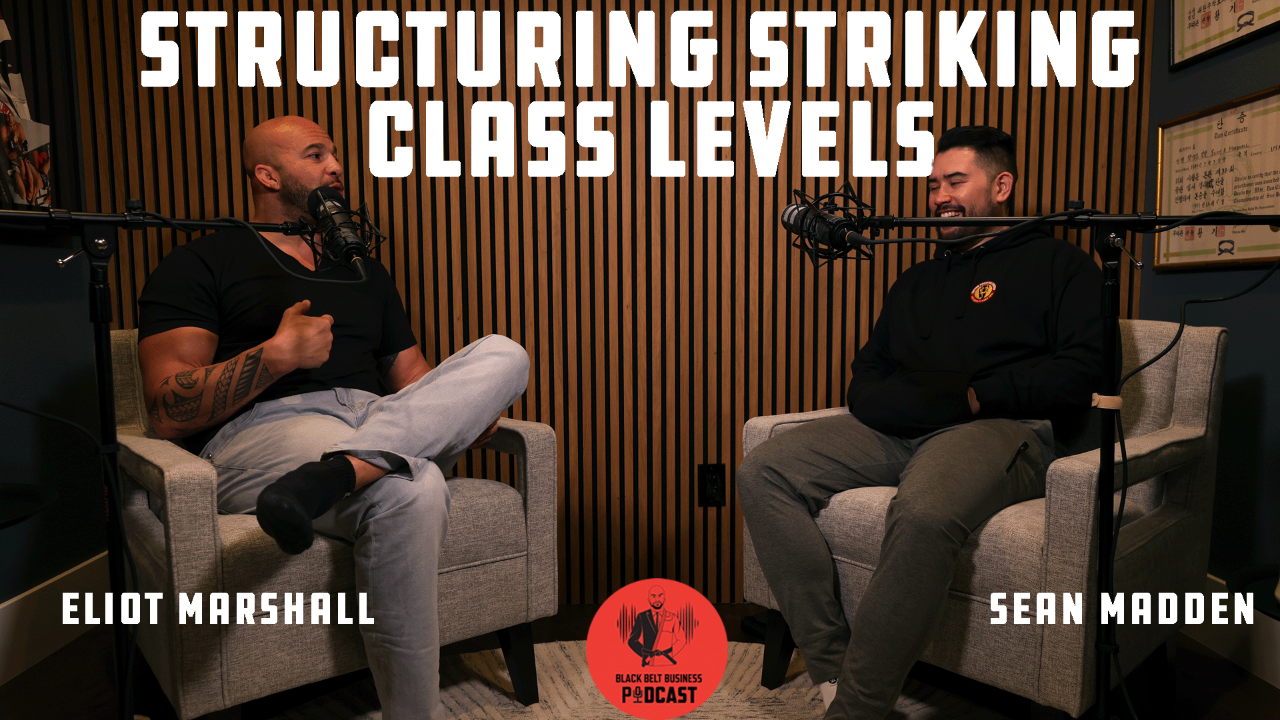
Why Class Structure and a Clear Ascension Path Are Essential for a Successful Muay Thai Program
Based on Episode 54 of the Black Belt Business Podcast
Most Muay Thai programs in America fail for one simple reason: they try to copy Thailand without understanding the context.
'In Thailand, gyms exist to produce fighters. The entire ecosystem revolves around the small percentage of people who compete, and the training structure reflects that.
But in the U.S., almost every student who walks through your doors is there for fitness, confidence, community, or personal growth. They aren’t fighters — and they will never become fighters.
This difference requires a completely different class structure, one built around clarity, progression, and safety. That’s where Easton’s system shines, and it’s the heart of Sean and Eliot’s discussion throughout Episode 54.
Level 1: Kickboxing
From the moment a new student arrives, everything is designed to give them the best chance of succeeding long-term.
Instead of being thrown into partner drills or pad holding on day one, beginners start in a simple Kickboxing class. Kickboxing is done on heavy bags and is focused on the basic techniques.
It’s intentionally basic. The movements repeat. The warmup never changes. And the structure stays the same every time the student returns.
They know exactly what to expect, which removes anxiety and allows them to focus on building the foundational mechanics they’ll need later.
Muay Thai Fundamentals
Kickboxing isn’t the destination — it’s the on-ramp. It prepares students for the next step: Muay Thai Fundamentals.
When they arrive in that room, it’s the first time they train with partners. They learn how to deliver strikes with control, how to receive contact, how to drill safely, and most importantly, how to hold pads correctly.
Pad holding is a skill many schools overlook, but at Easton, it’s treated as a core part of the Fundamentals experience. When students learn to hold well, the entire room improves.
Muay Thai Intermediate
By the time a student moves from Fundamentals into Intermediate, they’ve spent months building trust, consistency, and technical confidence.
This is where sparring begins, but only after students have earned the right to be there. They aren’t guessing anymore. They aren’t afraid. They aren’t getting thrown into rounds with athletes who are too advanced for them.
Instead, they arrive prepared — through a pathway that was intentional from the beginning.
This ascension model isn’t just about skill. It builds community.
Students progress with others who started around the same time. They grow together, learn together, and reach milestones together.
At Intermediate, you find students who are confident enough to challenge themselves and humble enough to help the people coming up behind them.
The students who wanted to spar on day one have learned patience. The ones who were terrified of sparring have developed courage. And when they meet in the middle, that’s where the culture becomes strong.
Structuring classes this way also solves one of the biggest problems school owners face: keeping advanced and beginner students in the same class.
When “all levels” is the only option, beginners get overwhelmed and advanced students get bored. You end up losing both groups.
With a clear system, students always have a next step to work toward, and instructors always know exactly what to teach.
The training becomes scalable — not dependent on any one coach, but supported by a shared structure that every coach can deliver.
What Sean and Eliot emphasize again and again is that class structure is not just a teaching tool.
It’s a retention tool. It’s a safety tool. It’s a culture tool. And ultimately, it’s a business tool.
A school with a clear ascension path can grow without sacrificing quality. A school without one eventually hits a ceiling.
The episode is a reminder that no matter how talented your coaches are or how passionate your students may be, none of it will matter without a system.
A great Muay Thai program doesn’t happen because of one charismatic instructor. It happens because every class, at every level, moves students forward with purpose.
And when you build a program that does that, students don’t just train longer. They stay longer. They progress further. And they become the community that keeps your academy thriving for years to come.
Get the Easton.Online Podcast directly to your inbox!
Enter your details below to get email notifications when new episodes get published.
We hate SPAM. We will never sell your information, for any reason.


