
Structuring Kids Jiu Jitsu Classes - Jordan Shipman (E59)
May 19, 2026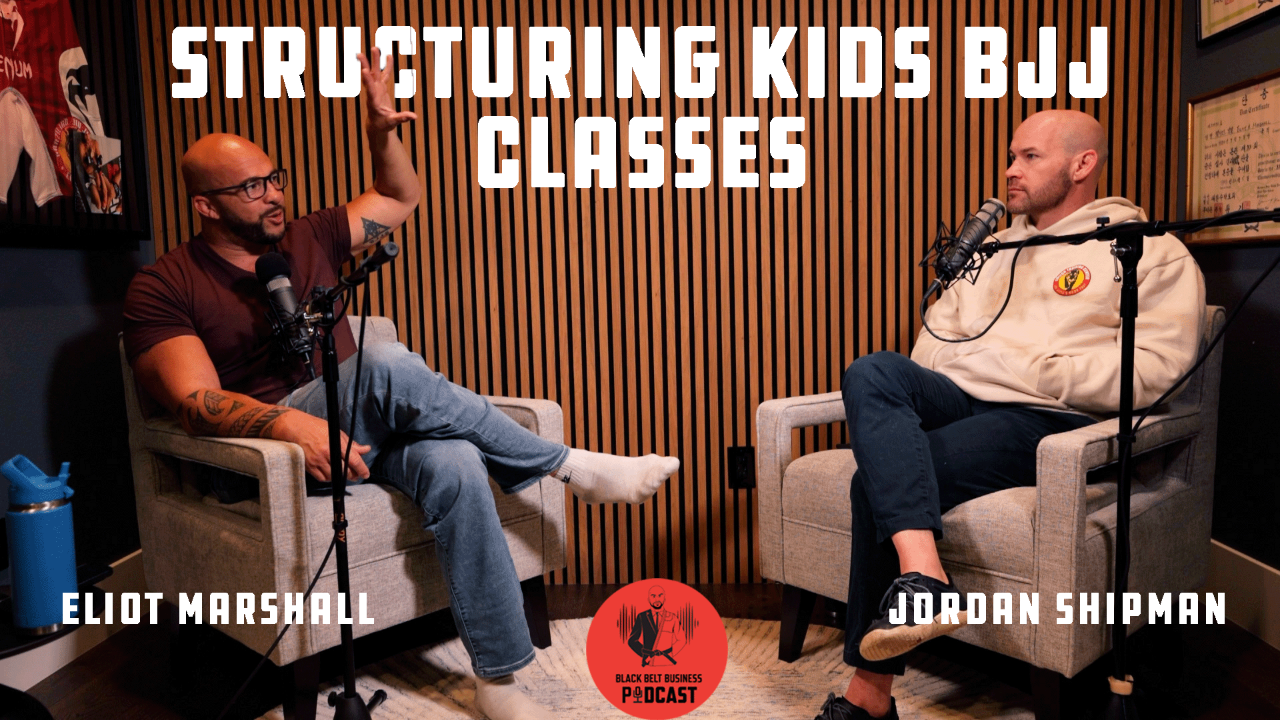
Structure Creates Success: How Great Kids Martial Arts Programs Are Built
Based on Episode 59 of the Black Belt Business Podcast
Running a successful kids martial arts program is about far more than teaching techniques.
If your classes aren’t structured correctly, everything falls apart.
At the exact moment class should be gaining momentum and engaging the students, kids stop paying attention, transitions between techniques and training become chaos, training time disappears.
And eventually, the entire experience breaks down.
In this episode of the Black Belt Business Podcast, Eliot Marshall and Easton Kids Program Director Jordan Shipman break down the systems, structure, and philosophy behind building a world-class kids program.
The conversation dives into everything from curriculum design and class management to emotional development, instructor training, and why consistency matters so much when teaching children.
At the center of it all is one key idea:
Structure creates success.
Without Structure, Kids Classes Become Chaos
One of the first points Jordan makes is simple but critical:
If your kids classes aren’t highly structured, they become chaotic almost immediately.
Every transition matters.
If students don’t know where to stand, how to move, or what comes next, instructors lose valuable time regaining control of the room.
Suddenly, a water break turns into ten minutes of distraction.
Next, a poorly explained drill causes confusion.
Then a transition between techniques creates disorder.
And suddenly half the class is gone.
That’s why Easton structures every segment of class with intentional time limits and repeatable systems.
The goal is consistency in every class.
What we've found is that kids thrive on routine.
The Long Game of Teaching Kids
One of the most interesting discussions in the episode centers around Easton’s Little Tigers program for younger students (think 4-6 year olds).
Jordan explains that when kids start training at four or five years old, the focus is not just martial arts technique.
The real priority is building foundational behaviors. At Easton, we use the acronym FRED:
Focus, Respect, Energy, Discipline
Fred is the kids' best friend, and they always need to bring their friend Fred to class.
These principles guide everything from class behavior to promotions.
Before a child can become great at Jiu Jitsu, they first need to learn how to participate in a structured environment.
That takes time and a focused emphasis on building the behaviors we want to see.
Over time it's become clear that what parents are looking for when they bring their young kids to a Jiu Jitsu academy isn't a kids who's a trained killer, rather a kid that is focused and disciplined.
If the kids don't bring F.R.E.D. to class, the whole thing starts to break down.
Why Easton Teaches Submissions to Young Kids
A major topic in the podcast is Easton’s decision to teach submissions even to very young students.
Some schools avoid this entirely, believing kids should only learn positions or basic movement first. We used to subscribe to this same ideal at Easton.
Until Jordan took over.
His argument is rooted in Easton’s core value of pursuing excellence. If competitions at that age allow submissions, then the school believes students should be taught the full art in an age-appropriate way.
That doesn’t mean throwing kids into chaotic live rounds.
Instead, the techniques are introduced gradually through highly controlled structure and repetition.
The philosophy is clear: You can simplify martial arts for children without watering it down.
The Importance of Repeatable Structure
One of the most valuable ideas from the episode is how important consistency is for kids.
Every class at Easton follows a familiar structure:
- Warmup
- Standing Technique
- Standing Live Training
- Ground technique
- More live Training
- Specific transitions and expectations throughout, including Mat chats
Even assistant instructors know exactly how every segment should run before stepping onto the mat.
That consistency creates stability.
Kids know what to expect. Staff at every Easton school, no matter the class level or time of day, know how to guide the room.
The culture becomes repeatable.
Jordan explains that assistant instructors are not just “extra bodies” on the mat. They are trained to model behavior, guide students physically when necessary, and reinforce the systems of the class.
That level of alignment is what allows the program to scale successfully.
Why Kids Need Physical Guidance
One of the more fascinating discussions in the episode focuses on how young children actually learn.
Jordan explains that with younger kids, verbal explanation alone often doesn’t work.
Instead, instructors physically guide students into the correct positions. We call this the "action figure" approach.
Like when we were kids ourselves playing with action figures, the kids sometimes require physical maneuvering to place them in the right position.
Rather than overexplaining every movement, coaches help kids feel the correct body position.
This approach matches how young children process information. At that age, learning is much more physical and experiential than verbal.
The result is faster understanding and less confusion.
Training Is Still the Goal
Even with all the structure and guidance, the hosts make one thing very clear:
The goal is still real martial arts training.
Jordan explains that eventually students need to train, struggle, and learn through experience.
That’s why Easton prioritizes preserving training time rather than endlessly extending technique instruction.
The struggle is part of the learning process.
Kids need opportunities to:
Problem solve
Compete
Fail
Adapt
That’s how confidence and resilience are developed.
Plus, live training is the fun part of Jiu Jitsu. Like Jordan points out, no one falls in love with Jiu Jitsu through drilling fundamental techniques for 10 years.
The real physical struggle and live problem solving that training creates is what captures long-term practitioners.
Why Emotional Moments Matter
Jordan and Eliot discuss how tears, frustration, and fear are completely normal parts of martial arts training for children.
The goal is not to avoid challenge.
The goal is to create an environment where kids can safely work through difficult emotions.
That’s where real growth happens.
A good kids program doesn’t try to make everything easy.
It teaches children how to handle discomfort, setbacks, and pressure in healthy ways.
That’s one of the biggest reasons parents enroll their children in martial arts in the first place.
If kids aren't crying from time to time, your class is probably too soft.
Don't take this the wrong way. We're not trying to make kids cry. We're not mean or overly demanding.
However, training is hard. Jiu Jitsu is hard. And learning how to push through tough moments is hard. Kids tend to have big emotions, meaning all this struggle is sure to illicit tears from time to time.
Instead of making class easier to avoid these emotions, your job as a coach is to turn these emotions into teachable moments.
Building Coaches for the Future
The episode also touches on a critical leadership lesson for school owners:
Your goal should be to develop instructors who eventually become better than you.
Eliot reflects on teaching Jordan early in his coaching career and points out that if a program falls apart when one instructor leaves, the system was never strong enough to begin with.
Strong schools create systems that allow future coaches to grow, improve, and eventually surpass previous generations.
Great coaches tend to make students who are better practitioners than they themselves were. If you're afraid of student surpassing you, coaching probably isn't something you should be doing.
We need the people who come after us to be better than we were.
That’s how sustainable programs are built.
Not around one person.
Around structure.
Great Kids Programs Are Built, Not Improvised
The biggest takeaway from this episode is that successful kids programs do not happen by accident.
They are engineered.
Every transition.
Every drill.
Every expectation.
Every assistant instructor.
All of it matters.
Because when structure is intentional, kids thrive.
And when kids thrive, the academy grows stronger for years to come.
Get the Easton.Online Podcast directly to your inbox!
Enter your details below to get email notifications when new episodes get published.
We hate SPAM. We will never sell your information, for any reason.


