
Mastering the Onboarding Experience (Pt. 3) - Ian Lieberman (E58)
Apr 19, 2026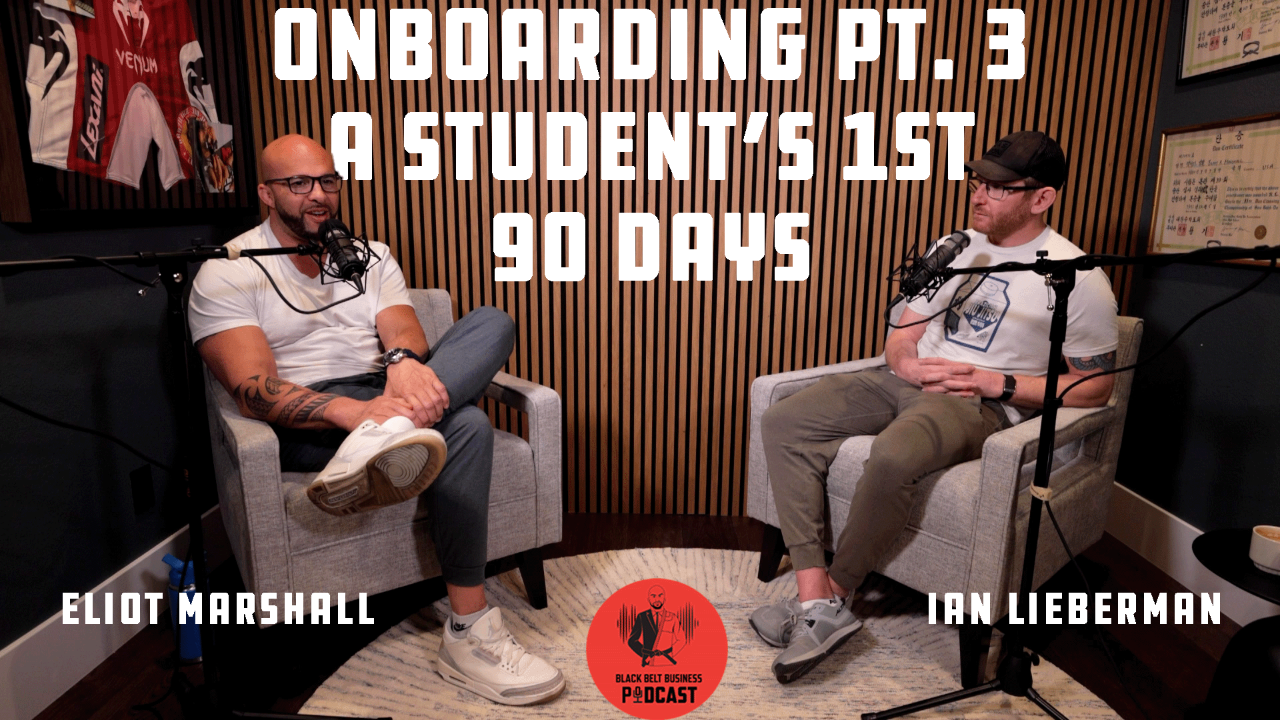
The First 90 Days: Where Martial Arts Schools Win or Lose Students
Based on Episode 58 of the Black Belt Business Podcast
Getting a new student signed up is only the beginning.
For most martial arts academies, the real battle starts after the first day.
In Part 3 of the onboarding series on the Black Belt Business Podcast, Ian and Eliot break down what in the first the first 90 days and why this period determines whether a student becomes a long-term member or quietly disappears.
If you’re not intentionally managing this phase, you’re leaving your retention up to chance.
And that’s a mistake most schools make.
Most Students Quit Before 90 Days
There’s a hard truth every school owner needs to understand: Most students don’t make it past their first three months.
That’s not because martial arts don’t work. It’s because the experience isn’t managed properly.
Students are overwhelmed. They’re unsure of their progress. They don’t feel connected yet.
And eventually, they stop showing up.
Most academy owners think they have a marketing problem. But the schools that grow aren’t the ones that get the most leads.
They’re the ones that keep people after they sign up.
You Can’t Leave the Experience to Chance
One of the biggest themes from this episode is simple: You have to engineer the student experience.
You cannot rely on memory or being “being a good coach.”
You cannot assume things will work themselves out.
From the moment someone signs up, their journey needs to be structured.
One way this is done at Easton is through a systemized follow-up process — often referred to as the 2-4-6 cadence.
-
2 days after signup
-
2 weeks
-
4 weeks
-
6 weeks
And even beyond that. These aren’t random check-ins. Rather, they're intentional touchpoints designed to guide the student, build connection, and keep them engaged.
This is where the CRM your school uses can be such a useful tool in retaining new students. Every interaction your staff has had with a new student from the moment they became a lead should be included in the CRM with notes on important details like:
The student's "Super Why," the reason that they chose to start martial arts.
The student's goals and progress they've made since starting.
And any mention they've made of struggles or successes throughout the 2-4-6 follow up process.
Why Follow-Up Matters More Than You Think
Most schools stop communicating after the sale and that’s where they lose people.
New students are unsure, nervous, and questioning if they made the right decision.
If you disappear during that time, they assume no one is paying attention.
Consistent follow-up changes that.
A simple message: “Hey, just checking in. How are you feeling?” can make a student feel seen, supported, and valued. Over time, this builds trust.
When a student feels supported and recognizes they're not just another "number" at your academy, they are less likely to quit right away.
The longer they stay, the more they see the benefits of training martial arts, which keeps them coming back for even longer.
Systems Beat Memory Every Time
One of the most important takeaways from this episode is the role of systems.
If your follow-up relies on memory, it will fail. Every time.
That’s why everything is tracked and scheduled through a CRM:
Calls.
Texts.
Emails.
Check-ins.
All of it is pre-planned and, is your CRM allows it, automated so nothing slips through the cracks.
Consistency is what creates results, not intention. If your system for remembering information about leads and new students, and when to follow up with them, is done in notebooks and sticky notes, you're going to continually drop the ball in the follow up process.
When new students cost $100 or more to get through the door and signed up at your school, can you really leave any of this up to chance?
The First 90 Days Are the Hardest
Martial arts are difficult. That’s part of the appeal.
But for a brand new student, it can also be overwhelming.
They don’t know what they’re doing. They feel uncomfortable. They question if they belong.
This is where most people quit.
Not because they don’t want to train. Because they don’t feel capable yet.
Your job as a school owner is to bridge that gap. This is where a strong front desk who recognize students and greet them by name can be a massive difference make for your school.
It's also where a strong fundamentals and onboarding program help new students feel welcomed, accepted, and like they can actually learn the martial arts you're teaching.
Fundamentals Classes Must Be Structured
Another major focus of the episode is how fundamentals classes should be designed.
Too many schools throw beginners into all-levels classes and expect them to figure it out.
That doesn’t work. The classes are either too advanced for beginners, or too remedial for your experienced students. This makes it so no one has a good experience.
A proper fundamentals program should be:
Structured
Repeatable
Progressive
Students need to feel like they’re learning something tangible every time they come in.
They need to experience progress. Both recognition from a coach (through promotions), and self-recognition of "getting it" are necessary to keep students motivated to continue training.
Progress Creates Retention
People don’t stay because something is “fun.” They stay because it’s satisfying.
There’s a difference: Fun is temporary. Satisfaction comes from progress.
When students feel like they’re improving, even in small ways, they keep coming back.
That’s why structured curriculum and early recognition (like stripes or milestones) matter.
When the fundamentals warm up is the same every time, a student is able to recognize that each time they movements get easier as they develop their skills.
If the units repeat, they're able to grasp a technique that seemed impossible the first time they tried it.
A structured and repeatable fundamentals program gives students proof that they’re moving forward.
Remove Ego, Build Skill
One of the most counterintuitive ideas discussed in the episode is removing “winning and losing” early on.
In the beginning, live training can create bad habits.
Students focus on surviving or “winning” instead of learning. And when their poor technique works against other people at the same belt level (think 1 or 0 stripe whitebelts), they internalize that technique. Once that happens, they have an even bigger hill to climb to unlearn their bad habits.
Instead of live training, fundamentals classes should prioritize:
Correct technique
Repetition
Understanding
This builds a real foundation.
And over time, that foundation produces better, more capable students.
Better Systems Create Better Students
There’s a misconception in martial arts that tougher training creates tougher students.
In reality, better systems create better students.
When you reduce overwhelm, provide structure, guide the experience, and track progress you create an environment where more people can succeed.
Not just the naturally tough ones. Those students are going to stick around no matter what. The true mark of a skilled martial arts instructor and high level academy is how well they take the unskilled and "weak" students and turn them into skilled martial artists.
Ultimately, strong systems mean more students stick around long enough to actually become skilled.
Retention Is the Business
There’s also a financial reality to all of this.
It costs money to acquire a new student. For Easton, that cost is around $100 just to bring someone through the front door. That's not including how much we pay staff to work the desk and coach the classes. Adding those expenses in, a new lead is even more valuable.
Because of this, most schools don’t actually become profitable on a member until they’ve been there for a few months.
If a student quits before 90 days, you lose money. If they stay, your business grows.
Retention isn’t just about culture. It’s about survival for your school.
The Schools That Grow Do This Differently
The difference between struggling schools and thriving ones isn’t talent.
It’s systems.
The best academies follow up consistently, structure their classes intentionally. track student progress, and support students early.
They don’t leave anything to chance. No post it notes to remind someone to follow up. No signing someone up and hoping they stay for 90 days.
The best academies build the student experience on purpose.
The First 90 Days Decide Everything
If you want to grow your martial arts academy, you need to focus on what happens after the sale.
Because that’s where most schools lose.
The first 90 days are where students decide:
Do I belong here?
Am I getting better?
Is this worth continuing?
Your systems, your communication, and your class structure answer those questions for them.
If you get it right, you don’t just keep students, but you build a school that lasts.
Get the Easton.Online Podcast directly to your inbox!
Enter your details below to get email notifications when new episodes get published.
We hate SPAM. We will never sell your information, for any reason.


