
Jiu Jitsu Curriculum and Class Structure - Alex Huddleston (E62)
Aug 19, 2026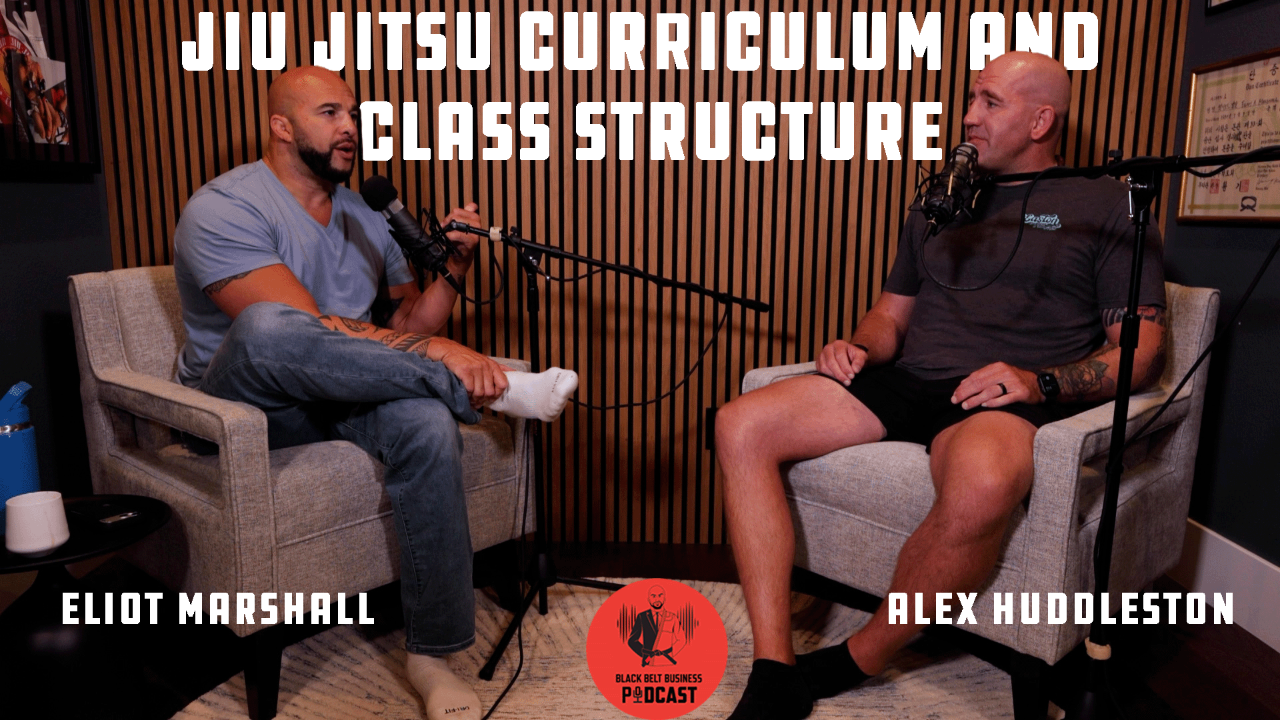
Why Your Jiu Jitsu School Needs a Curriculum
Based on Episode 62 of the Black Belt Business Podcast
For a long time, Jiu Jitsu schools didn't really have curriculums.
You showed up to class and learned whatever the instructor felt like teaching that day.
Monday might be an armbar.
Tuesday might be a side control escape.
Wednesday might be something completely unrelated.
If you stuck around long enough, eventually everything started making sense.
The problem is that a lot of people didn't stick around long enough.
Thats why Easton's approach to Jiu Jitsu curriculum has evolved and why having a structured progression has become such an important part of developing students, instructors, and successful academies.
"If You Stick Around Long Enough"
When Alex thinks back to learning Jiu Jitsu without a curriculum, he remembers the techniques feeling like separate islands.
You learned plenty of moves, but understanding how those moves connected was much more difficult.
Eventually, experienced students figured it out.
That's one of the amazing things about Jiu Jitsu. Spend enough time training and the pieces start coming together.
But there's an important phrase there:
If you stick around long enough.
How many students didn't?
How many potentially great martial artists walked into a school, felt completely overwhelmed, and never came back?
Beginners already have enough working against them.
They don't know what guard means. They don't understand the hierarchy of positions. They don't know what they're supposed to accomplish.
Many are intimidated just walking through the front door.
Throwing random techniques at those students and expecting them to eventually figure everything out creates another unnecessary barrier to their success.
A curriculum gives them a path.
Teach Students to Move, Not Just Moves
One of the most important ideas Eliot and Alex discuss is the difference between teaching moves and teaching students to move.
Imagine teaching a beginner a guard pass.
They drill it repeatedly.
Then they start training, successfully pass someone's guard and stop.
Why?
Because they completed the move they learned.
But Jiu Jitsu didn't stop when they passed the guard.
They need to establish control, advance position, react to their opponent, and eventually find a submission.
Students need to understand how the individual technique fits into the larger system.
That's where curriculum becomes incredibly valuable.
Instead of simply memorizing techniques, students begin learning the underlying principles connecting them.
They start understanding where they're going and why they're going there. Eventually, they're not simply repeating what their instructor showed them.
They're learning Jiu Jitsu.
Fundamentals Should Give Beginners What They Need
At Easton, that process begins with a dedicated fundamentals curriculum.
The roots of Jiu Jitsu are in self-defense, so beginners first need to understand how to keep themselves safe.
That means learning things like how to fall, how to be a safe training partner, positional hierarchy, why being on top is generally preferable, how to protect yourself from the bottom, and how to establish control.
There might be countless techniques students eventually learn, but the underlying principles remain relatively consistent.
A structured fundamentals curriculum allows instructors to expose beginners to those principles intentionally instead of hoping students piece everything together themselves.
Why Easton Doesn't Immediately Throw Beginners Into Live Training
Here's where Easton's approach can become controversial.
Students in the fundamentals program don't immediately participate in full live training.
That doesn't mean they experience zero resistance.
They work through predetermined situations and positional training with controlled resistance so they can begin experiencing pressure without being completely overwhelmed.
Learning how to train live is itself a skill.
Our philosophy is to introduce that skill progressively.
Give students enough knowledge to understand the game. Then introduce resistance.
Let them experience difficult positions. Build confidence and understanding. Then increase the intensity.
Just because some of us survived being thrown into the deep end on our first day doesn't mean that's the best way to teach the next generation of students.
The Problem With Only Offering All-Levels Classes
All-levels classes have a place in a Jiu Jitsu academy.
Easton has them too.
The problem comes when they're the primary or only way students learn.
When you're trying to teach everyone from a first-day white belt to a purple belt in the same room, who exactly is the class for?
Teach something too complicated and the beginner is completely lost.
Teach something too basic and experienced students stop being challenged.
Eventually, you can end up teaching toward the middle.
The beginners quit because they're overwhelmed. The advanced students leave because they're bored.
A tiered curriculum allows you to meet students where they actually are in their development.
Fundamentals, Intermediate, Advanced
Easton's solution is a progression through different levels of Jiu Jitsu instruction.
Fundamentals provides the foundation.
Students learn self-defense concepts, positional hierarchy, movement, safety, and the fundamental principles they'll need throughout their Jiu Jitsu journey.
Around the three-month point, students move into intermediate training and are introduced to full live training. Now they're learning how to use Jiu Jitsu against someone who also knows Jiu Jitsu.
The game becomes more complex.
Students learn more sport-specific techniques, experience true positional training, and begin understanding how their opponent's system interacts with their own.
By the advanced level, the goal changes again.
Students already understand the pieces. Now they need to figure out how those pieces fit together for them. That's where individual games and specialties begin to develop.
Your Advanced Students Shouldn't Be Copies of You
This is another major advantage of thinking about Jiu Jitsu systematically.
Your job as an instructor isn't to create 100 copies of yourself.
Different students have different bodies, personalities, strengths, and preferences.
A technique that's perfect for a 200-pound instructor may not be the best foundation for a 125-pound student.
At the advanced level, Easton gives instructors more freedom to read the room and help students develop individual games using the foundation they've already built.
That also places a bigger responsibility on advanced instructors.
They have to keep studying. They can't simply teach their own game forever.
Jiu Jitsu constantly evolves, and great instructors need enough understanding to help students pursue techniques and systems they may not personally use.
Curriculum Doesn't Mean Removing Creativity
Some instructors hear "curriculum" and imagine being handed a rigid document telling them exactly what to teach forever.
That's not the goal.
In fact, a good curriculum can create more room for creativity.
Once students understand the fundamental principles and systems, they have a framework from which they can experiment.
They can develop their own styles. They can bring new techniques back into the academy. Instructors can learn from students.
The entire room continues evolving.
That's why Easton views curriculum as a living thing.
When Jiu Jitsu changes, the curriculum should be able to change with it.
New techniques emerge. Existing techniques become more efficient.
Competition exposes weaknesses.
Students and instructors discover better ways of solving problems.
The curriculum needs to capture those lessons instead of becoming a document that was written once and followed forever.
Structure Helps You Scale Great Jiu Jitsu
For school owners, there's another major benefit.
Curriculum creates consistency.
At Easton, a fundamentals student should receive a similar experience regardless of which Easton academy they visit or which instructor is teaching. The same applies to the intermediate program.
That's incredibly important as an academy grows.
If the quality of your Jiu Jitsu program depends entirely on you being on the mat, there's a ceiling on how far your school can go. You need to develop instructors who can deliver great classes without you.
But before you can train someone to teach a great class, you have to define what they're supposed to teach.
That's where curriculum becomes much more than a collection of techniques.
It's a system for delivering your martial arts.
Curriculum helps beginners understand what they're doing. It gives intermediate students a clear path forward. It gives advanced students the foundation to develop their own games.
It gives instructors a framework for delivering consistent classes.
And it gives school owners the ability to maintain their standards as the academy grows.
The old approach proved that students could eventually become great if they survived long enough.
A great curriculum asks a better question:
How can we give more students the tools they need to succeed from the beginning?
Get the Easton.Online Podcast directly to your inbox!
Enter your details below to get email notifications when new episodes get published.
We hate SPAM. We will never sell your information, for any reason.


