
Developing Kids Jiu Jitsu Coaches - Jordan Shipman (E60)
Jun 19, 2026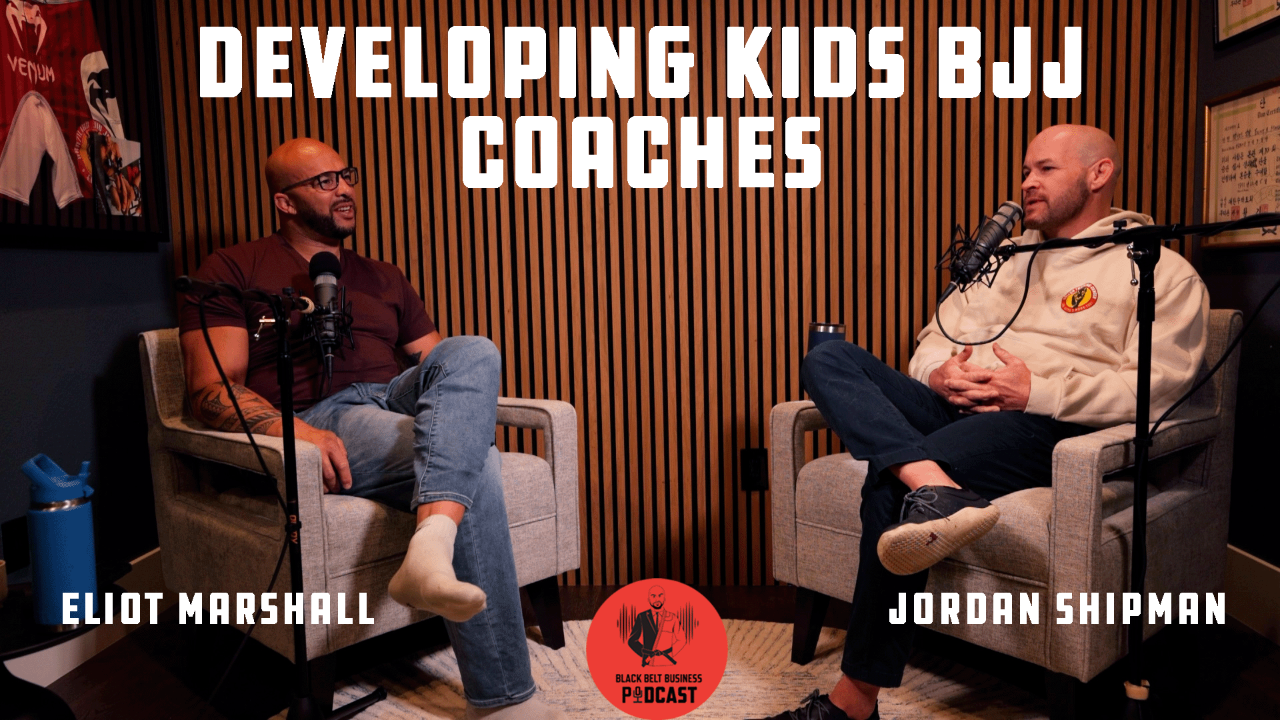
Great Kids Programs Aren't Built by Great Instructors Alone
Based on Episode 60 of the Black Belt Business Podcast
Most martial arts school owners think the quality of their kids program comes down to one thing:
Finding a great instructor.
They're not wrong, a great instructor matters.
But if your kids program depends on one person, you've already created a major weakness in your business.
What happens when that instructor gets sick? What happens when they move away? What happens when they get promoted into another role?
What happens when your program grows faster than your staffing can support?
The answer isn't finding a superhero instructor, it's building bench strength.
The Biggest Difference Between Kids and Adult Programs
Adult classes are relatively easy to run.
You can walk into an advanced class, explain a technique, and let experienced students take over much of the learning process themselves.
Kids classes don't work that way.
Kids require constant engagement, feedback, and supervision.
A room full of children cannot be managed effectively by one instructor, no matter how talented that instructor may be.
That's why Easton operates with strict coach-to-student ratios and multiple instructors on the mat for every kids class.
Is it possible to teach with fewer coaches? Yes.
But it's impossible to deliver excellence with fewer coaches. There is a difference.
Many school owners fall into the trap of asking: "Can I make this work?"
The better question is: "What's best for the students?"
When Programs Start Declining
One of the most dangerous moments for any school happens when standards slowly begin to slip.
First, an assistant coach moves away. Then another goes to college. Someone else gets busy with work.
Suddenly a class that used to have four coaches has one.
The lead instructor makes it work. Then they make it work again.
And again.
Before long, operating short-staffed becomes normal. That's when quality starts to decline.
Parents notice. Students stop progressing as quickly.
New students don't get enough individual attention and suddenly you can no longer retain students for enough time to make an impact in their lives.
Owners begin looking for external explanations to justify the changes in attendance and membership.
"Kids are softer now."
"The economy is different."
"Families are busier."
Maybe some of this is true some of the time.
But sometimes the real answer is much simpler: your program isn't as good as it used to be.
The strongest school owners are willing to look inward before making excuses.
Why Parents Say Classes Are "Too Big"
One of the most insightful points from the episode is Jordan's observation that parents often misdiagnose the problem.
Parents frequently say: "The class is too big."
But that's usually not what they mean.
What they really mean is: "There aren't enough coaches."
A class of 40 students can feel amazing if there are enough instructors providing attention, feedback, and guidance.
A class of 20 (or even 10) can feel overwhelming if students are constantly lost and waiting for help.
Parents don't count students, they evaluate the experience.
If their child feels supported, the class feels great.
If their child feels ignored, the class feels crowded.
That's an important distinction.
Bench Strength Is Not Optional
The best programs are constantly recruiting future instructors.
Not because they need help today, because they know they'll need help tomorrow.
Jordan explains that Easton's philosophy is simple:
Always stay ahead of your current needs.
If your staffing perfectly matches today's attendance, you're already behind. Because successful programs grow. New students are always arriving and classes continue to expand.
If you wait until you're short-staffed to recruit and train coaches, you're already in trouble.
Great schools don't react, they prepare.
Systematizing Coach Development
This is where most martial arts schools struggle.
They know they need more coaches, but don't know how to develop them consistently.
Easton solved this problem through systems.
Every new kids coach completes a structured onboarding program that teaches:
- Class structure
- Safety protocols
- Coaching tactics
- Training philosophy
- Expectations
- Point systems
- Staff responsibilities
The goal isn't to create a master instructor overnight.
Instead, the goal is to create consistency.
Every coach learns the same standards, understands the same philosophy, and speaks the same language.
The result is a more predictable student experience.
Training Coaches Like You Train Students
One of the strongest parallels in this episode is the comparison between developing instructors and developing martial artists.
Nobody expects a white belt to become a black belt overnight.
Yet many school owners expect coaches to magically know how to teach.
Just as students need structure and repetition, instructors need structure and repetition.
The onboarding process doesn't create expert coaches. It gives new coaches a foundation to grow.
From there, experience, mentorship, and mat time take over.
Not Everyone Should Coach Kids
Another important lesson from the conversation is that coaching kids isn't for everyone.
Some people simply want free training. Others are looking for a trade arrangement.
But great kids coaches genuinely care about helping children.
They enjoy teaching, mentoring, and creating positive experiences.
Those are the people who become long-term assets to a program.
Teaching kids cannot be just another task for coaches.
Building a Program That Lasts
The biggest takeaway from this episode is simple:
Your kids program should not depend on one person.
It should depend on systems.
Systems create consistency, develop coaches, and are scalable.
And most importantly, systems create better experiences for students.
A great instructor can carry a program for a while.
A great system can carry a program for decades.
If you want a kids program that continues to grow, continues to retain students, and continues to develop future leaders, stop asking how good your lead instructor is.
Start asking how strong your bench is.
Get the Easton.Online Podcast directly to your inbox!
Enter your details below to get email notifications when new episodes get published.
We hate SPAM. We will never sell your information, for any reason.


