
Developing and Training Jiu Jitsu Coaches - Alex Huddleston (E63)
Sep 19, 2026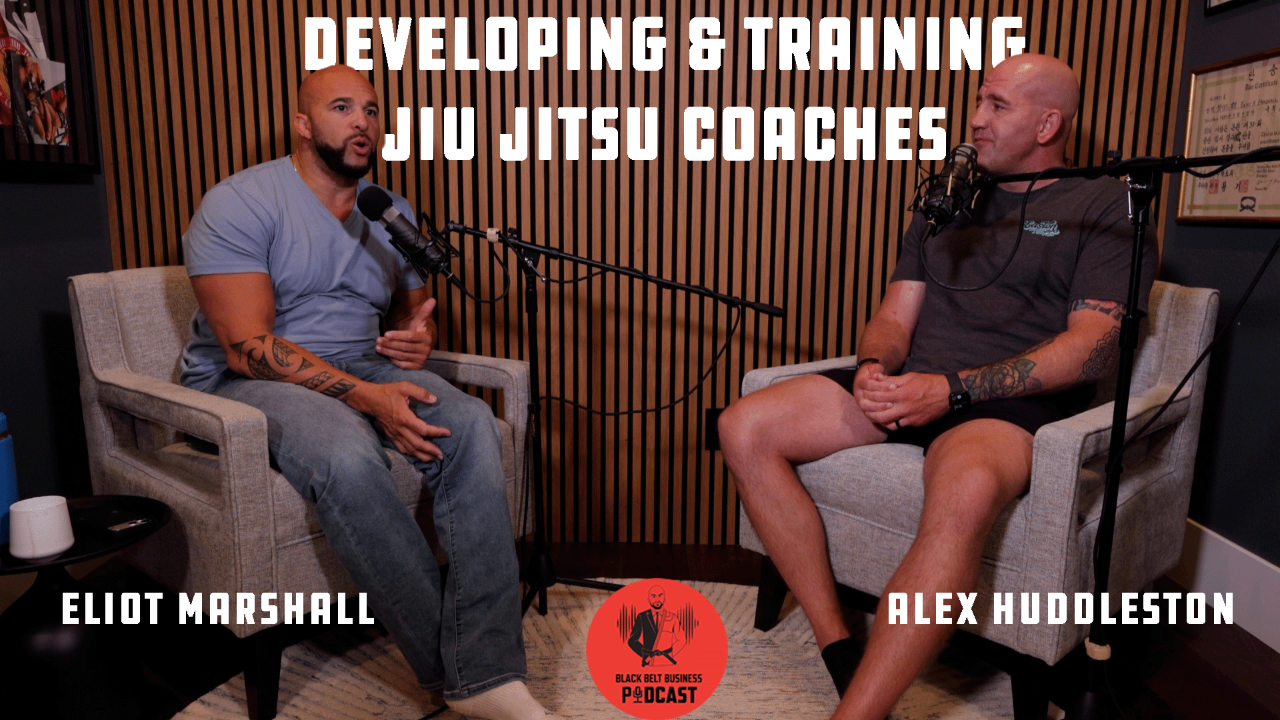
Great Martial Arts Schools Don’t Just Find Great Instructors. They Build Them.
Based on Episode 63 of the Black Belt Business Podcast
One of the biggest challenges martial arts school owners eventually face is getting themselves off the mat.
In the beginning, you might teach nearly every class. You know exactly how you want techniques presented, how students should be treated, how the room should be managed, and what a great class at your academy should feel like.
Then the school grows.
You need more classes. You need more instructors. Maybe you want to open another location.
Suddenly, knowing how to teach a great class yourself isn't enough.
You have to figure out how to teach someone else to teach a great class.
In the most recent episode of The Black Belt Business Podcast, Eliot Marshall and Alex Huddleston discuss how Easton approaches instructor development and why a structured curriculum is only the beginning.
If you want to grow your academy without losing the quality of your product, you need a repeatable system for developing the people who deliver it.
Curriculum Gives Your Instructors a Common Language
One of the reasons Easton believes so strongly in curriculum is that it creates a shared foundation for instructors.
Coaches use similar terminology. They understand the principles behind the techniques. They share an operating perspective on how Jiu Jitsu should be taught and how students should progress through the program.
That consistency becomes increasingly important as you add instructors.
Without it, every instructor can essentially create their own version of your program.
One coach teaches one way. Another uses completely different terminology. Another skips foundational concepts because they assume students already understand them.
Eventually, the student experience depends entirely on who happens to be teaching that night.
A curriculum gives everyone a shared starting point.
It doesn't mean every instructor needs to have the same personality or become a copy of the head instructor. It means they're operating from the same system.
Being Good at Jiu Jitsu Doesn't Automatically Make You a Good Instructor
One of the most important ideas from this episode is simple:
Teaching is a skill.
Being a great competitor doesn't automatically make someone a great instructor.
An experienced practitioner may perform movements without consciously thinking about every step anymore. Those skills have become automatic.
But a beginner doesn't have that experience.
A good instructor needs to be able to work backward, break down what they're doing, and explain it from the student's perspective rather than their own. Instructors need to understand what a technique looks like to someone who hasn't already crossed that developmental gap.
That's why choosing instructors based entirely on rank or competition success can be a mistake.
Technical ability matters.
But so do communication, empathy, leadership, and the ability to teach.
Start Looking for Instructors Before You Need Them
Easton's instructor development process starts with scouting.
They're looking for students who are passionate about Jiu Jitsu, challenge themselves, communicate well, build good relationships inside the academy, and understand what the school is trying to accomplish.
That's an important shift for school owners.
Don't wait until you desperately need someone to cover Tuesday night before deciding to develop an instructor.
Look around your academy now.
Who consistently shows up?
Who helps newer students?
Who communicates well?
Who represents the culture you want?
Who seems genuinely invested in the academy and the martial art?
Those students may be the beginning of your future coaching staff.
Don't Hand Someone a Class and Hope They Figure It Out
Once Easton identifies a potential instructor, they don't simply put that person on the schedule.
There's onboarding followed by a structured shadowing process.
For a new instructor, Easton requires roughly 30 hours of shadowing.
The first ten classes are primarily observation.
The next ten move into assisting.
During the final ten, the instructor begins taking responsibility for larger portions of the class.
The process gradually starts looking more like an apprenticeship. New instructors take on responsibilities in small pieces while receiving feedback from the experienced instructor they're working with.
Think about how different that is from:
"Hey, can you teach class Thursday?"
One approach hopes someone knows how to teach.
The other develops their ability to teach.
Give People a Chance to Learn Without Needing to Be Perfect
Instructor training also requires giving people room to make mistakes.
It's important to not constantly interrupta new instructor while they're teaching.
Unless there's a safety issue, feedback can wait until after class.
The goal is to create accountability rather than dependence. If an experienced instructor constantly jumps in and corrects every small mistake, the new coach may start believing that anything short of perfection means they're failing.
Instead, let them teach.
Observe.
Then talk afterward about what went well and what they can improve.
That gives the developing instructor ownership of the class while still providing the coaching they need.
Your instructors need reps just like your students do.
Train Instructors for the Room They're Actually Leading
Not every class requires the same coaching skills.
A fundamentals instructor needs to be excellent at introducing Jiu Jitsu to newer students, helping them control their pace, and teaching them how to be good training partners.
Intermediate is different.
Live training is being introduced. Intensity increases. The instructor needs enough experience to manage a room where students are beginning to compete against each other more directly.
That's why Easton trains instructors specifically for the level they're going to teach.
Advanced instruction has an even higher bar.
At that level, Easton is looking for instructors with a body of work behind them: years on the mat, senior rank, competition experience, and demonstrated expertise.
The lesson for school owners is that "instructor" shouldn't necessarily be a single qualification.
Someone might be ready to teach fundamentals without being ready to lead your highest-level class.
Create a pathway.
Let instructors develop just like students do.
Instructor Development Doesn't End When Someone Gets a Class
Finishing the initial training process isn't the end.
Your coaches still need coaching.
Easton continues instructor development through meetings and ongoing training. Eliot and Alex discuss the role of the head instructor and a meeting cadence designed to keep developing the rest of the teaching staff.
That's an important distinction.
If instructors only receive training before their first class, you're treating teaching like a certification.
If you want instructors to continually improve, treat teaching like a practice.
Review what's working.
Talk about problems.
Train communication.
Discuss difficult situations.
Revisit teaching standards.
Give feedback.
The same principle that makes your students better at martial arts applies to your staff:
Repetition and coaching create improvement.
Your Ability to Develop Instructors Determines Your Ability to Scale
For many academy owners, this is where instructor training stops being just a product issue and becomes a business issue.
If you're the only person capable of delivering your product at the standard you expect, your growth will always be limited by your personal capacity.
You can only teach so many classes.
You can only be in one room at a time.
And you definitely can't personally teach at two locations simultaneously.
Growth requires transferring your standards to other people.
That's why curriculum, onboarding, shadowing, feedback, level-specific training, and continued instructor development matter so much.
They're not separate systems.
Together, they create a pathway:
Student → Potential Coach → Trainee → Assistant → Instructor → Experienced Instructor → Leader
The goal isn't to find another version of yourself.
It's to build a system that helps good people become great instructors while preserving the standards and culture of your academy.
Build the System Before You Need It
A lot of school owners don't think seriously about instructor development until they're already overwhelmed.
They're teaching too many classes.
They need coverage.
They're trying to grow.
And suddenly they're asking someone who has never taught before to take over a room.
That's a difficult time to start building a training system.
Instead, begin developing your bench before you desperately need it.
Identify potential instructors.
Give them a curriculum to operate from.
Let them observe great teaching.
Allow them to assist.
Give them opportunities to lead.
Coach them afterward.
Then keep training them once they're on the schedule.
Because ultimately, scaling a martial arts academy isn't just about getting more students through the door.
It's about developing enough great people to give those students a great experience once they're inside.
Get the Easton.Online Podcast directly to your inbox!
Enter your details below to get email notifications when new episodes get published.
We hate SPAM. We will never sell your information, for any reason.


