
Creating a Competition Culture in you Jiu Jitsu School - Alex Huddleston (E64)
Oct 19, 2026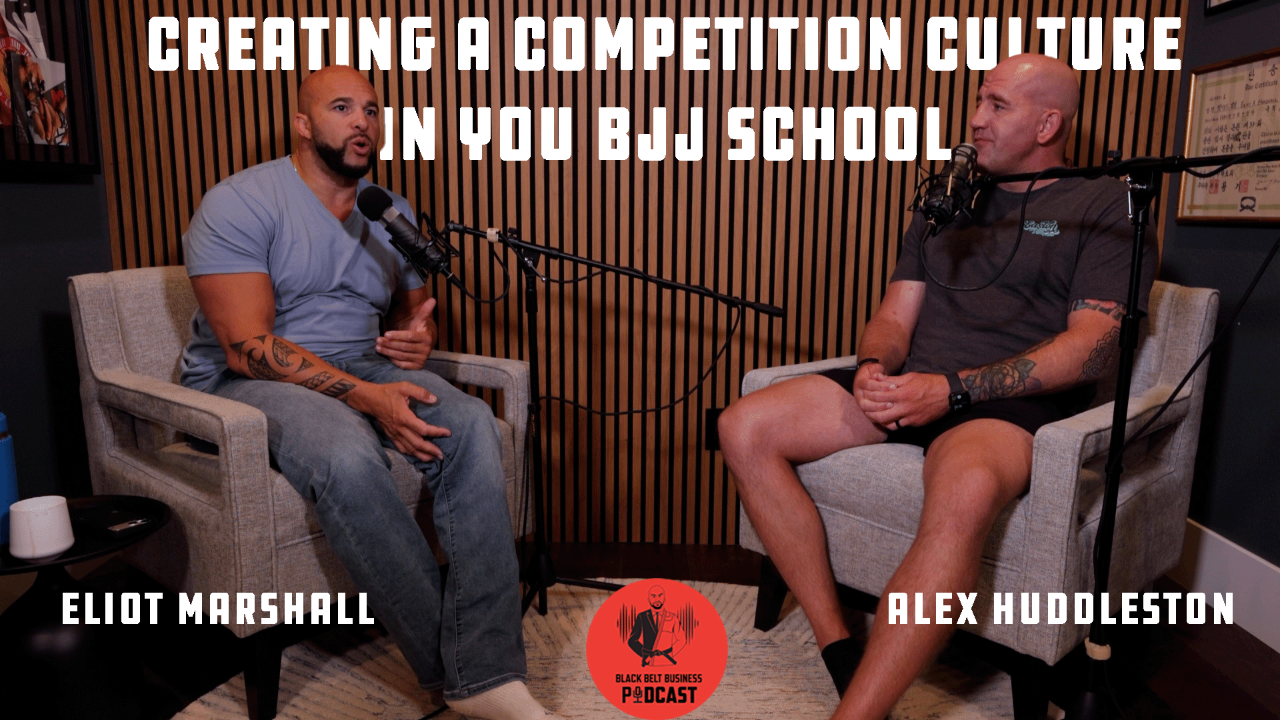
Why Every Jiu Jitsu Academy Needs a Competition Culture
Based on Episode 64 of the Black Belt Business Podcast
Not every student at your academy needs to compete. But competition should still be an important part of your school.
For many martial arts school owners, competition presents a challenge. You want to develop high-level practitioners and maintain the integrity of your martial art, but you also need to create an environment where beginners, hobbyists, and families feel comfortable training.
Can you do both?
At Easton, we believe you have to.
In the latest episode of the Black Belt Business Podcast, Eliot Marshall and Adult Martial Arts Program Director Alex Huddleston discuss why competition is essential to developing great Jiu Jitsu, how it influences the quality of instruction, and what it takes to build a competition program without sacrificing the experience of your everyday students.
Competition Keeps Your Jiu Jitsu Honest
One of the most important things competition does is test whether your Jiu Jitsu actually works.
There is a significant difference between executing a technique against a cooperative training partner and trying to make that same technique work against someone who is doing everything possible to stop you.
In the training room, you can practice a triangle choke hundreds of times and feel confident in your technique. But when you get into a competition against someone resisting at full intensity, you might discover that the adjustments you thought were unnecessary are actually essential.
That experience changes the way you understand Jiu Jitsu.
It also changes the way you teach it.
An instructor who has experienced competition understands the details that become important when techniques are tested against real resistance. They can explain not just how a technique works, but what happens when an opponent actively tries to shut it down.
At Easton, we talk a lot about teaching battle-tested Jiu Jitsu.
We don't want our instructors teaching techniques that only work under ideal circumstances. We want them teaching from experience, with an understanding of what happens when someone genuinely fights back.
Competition provides a standard that helps keep the quality of your instruction high.
You Don't Need an Academy Full of Competitors
This is where martial arts school owners need to understand an important distinction.
Building a competition culture does not mean building an academy exclusively for competitors.
In fact, for most schools, that would be a difficult business model to sustain.
The majority of your students aren't trying to become world champions. They're training to get in shape, learn self-defense, develop confidence, make friends, or challenge themselves.
Those students are the foundation of a successful academy.
If you structure your entire school around the needs of your most competitive athletes, you risk creating an environment that doesn't serve the majority of your membership.
But the opposite approach is just as problematic.
If you eliminate competition entirely because most students aren't interested in it, you risk lowering the technical standards of your academy over time.
At Easton, we believe the solution is to create an environment where recreational students and competitors can both succeed.
Competition shouldn't be the only focus of your academy, but it needs to be one of them.
The Competitor Mindset Benefits Every Student
One of the biggest points Alex makes in this episode is that being a fighter isn't necessarily about entering tournaments.
It's a mentality.
You can be a hobbyist who never competes and still approach your training with the mindset of a competitor.
That means choosing difficult rounds, challenging yourself against better training partners, attending demanding classes, and consistently pushing beyond your comfort zone.
Those experiences are valuable whether you ever step onto a competition mat or not.
When students are exposed to a culture that values effort, discipline, and continuous improvement, the standard of the entire academy rises.
The goal isn't to turn every member into a professional athlete.
The goal is to build an academy where students understand that improvement requires effort and where challenging yourself is a normal part of training.
Competition Builds Confidence That Training Alone Can't
Competition also creates opportunities for personal development that are difficult to replicate in a regular class.
When you compete, you experience a level of pressure and intensity that is different from everyday training.
You prepare for weeks, put yourself in an uncomfortable situation, and test your abilities in front of other people.
Sometimes you win. Sometimes you lose.
Either way, you learn something about yourself.
Eliot and Alex discuss how the experience of competing changes your perspective. Once you've experienced that level of intensity, the challenges you face in your normal training environment can become easier to manage.
You understand what it feels like to operate under real pressure.
You also learn that losing isn't the end of the world.
That lesson is especially valuable for beginners.
At Easton, we encourage students to experience competition early in their Jiu Jitsu journey, including competing as white belts before earning their blue belts.
The earlier students experience competition, the sooner they can begin developing the confidence and resilience that come from putting themselves in challenging situations.
And those lessons extend well beyond Jiu Jitsu.
The medals eventually end up in a box somewhere. The experience stays with you.
You Have to Intentionally Develop a Competition Culture
A strong competition program doesn't happen by accident.
Most students aren't going to see a tournament advertisement and decide to sign up on their own.
Competition is intimidating, especially for someone who has never done it before.
Students need encouragement, preparation, and leadership.
That starts with your instructors.
When coaches have competition experience and actively support students who want to compete, it establishes a standard throughout the academy.
Students begin to see competition as a normal part of the Jiu Jitsu experience rather than something reserved for a small group of elite athletes.
But encouragement alone isn't enough.
You also need systems that support the students who decide to compete.
That means creating opportunities for competition-specific training, helping students prepare for tournaments, and making sure they have the coaching they need to succeed.
Your Competition Classes Need to Be Different
One of the biggest mistakes a school can make is trying to develop serious competitors entirely within its regular class structure.
Eliot makes the point that if you try to turn every regular class into a competition class, you're likely to create one of two problems.
Either the training becomes too intense for your average student, or it isn't demanding enough to prepare your competitors.
Neither outcome is good for your academy.
Your regular classes need to provide a great experience for the majority of your members.
Your competitors need additional opportunities to prepare for the demands of competition.
That's why Easton creates dedicated competition training environments.
These sessions are designed to push athletes beyond what they would experience in a normal class.
But even within your competition program, you need to recognize that different athletes have different needs.
A young adult competitor preparing for a major tournament shouldn't necessarily train the same way as a masters competitor balancing training with work, family, and recovery.
The intensity, pacing, and preparation need to reflect the athletes you're working with.
The lesson for school owners is simple: different students need different training environments.
Trying to serve everyone with the exact same class structure limits what you can accomplish.
Coaching Competitors Is Different From Teaching Classes
Another important distinction Eliot and Alex discuss is the difference between being an instructor and being a coach.
Teaching a great Jiu Jitsu class requires technical knowledge, communication skills, and the ability to help students understand new concepts.
Coaching competitors requires additional skills.
A competition coach needs to know how to challenge athletes, motivate them, manage their preparation, and push them beyond what they think they're capable of.
They also need to build strong relationships.
You have to understand what motivates each athlete, what challenges them, and how to help them respond when things aren't going well.
Sometimes that means having difficult conversations.
Sometimes it means pushing someone harder than they want to be pushed.
And sometimes it means recognizing when an athlete needs support rather than more intensity.
You can't develop great competitors simply by putting your most technical instructor in charge of competition class.
You need someone who understands how to coach.
For academy owners, this is another reason instructor development needs to be intentional. The skills required to teach fundamentals, lead advanced classes, and coach competitive athletes are not identical.
Your training systems should reflect those differences.
Competition Should Make Your Entire Academy Better
The biggest takeaway from this episode isn't that every martial arts school needs to produce world champions.
It's that competition serves a purpose beyond the students who participate in it.
It gives your instructors firsthand experience with high-level resistance.
It provides feedback about which techniques and approaches are effective.
It challenges students to develop confidence and resilience.
It establishes a standard of effort and technical quality that influences the entire academy.
And when you build the right systems around it, competition can strengthen your school without taking away from the experience of your recreational members.
For martial arts school owners, that's the balance worth pursuing.
You need a welcoming environment where beginners can succeed.
You need structured classes that help students develop safely and consistently.
And you need a competition culture that continues to test and elevate the martial art you're teaching.
The goal isn't to make everyone compete. It's to make sure competition continues to make everyone better.
Get the Easton.Online Podcast directly to your inbox!
Enter your details below to get email notifications when new episodes get published.
We hate SPAM. We will never sell your information, for any reason.


